TL;DR: Private label garden tools let a distributor or garden centre sell factory-direct product under their own brand, packaging, and spec. This post covers OEM vs private label, what you can realistically customize, MOQs and lead times, common launch mistakes, and what to line up before you place the first order.
If you sell generic garden tools, the margin story is not getting better. Marketplaces publish your cost, chain buyers benchmark you against the same SKU three ways, and the supplier you rely on is often quoting your competitors from the same price list.
Private label garden tools change that. You keep the factory relationship and the unit economics, but the product on the shelf carries your brand, your packaging, and your spec choices. It is the most direct way for a small or mid-size distributor to defend margin and stop competing on someone else’s catalogue. Consumer demand is also moving in the right direction.
A NielsenIQ global outlook found that half of global shoppers say they are buying more private label products than ever before. This post covers what OEM and private label actually mean, what you can customize, what the launch timeline looks like, and where first-time brand buyers get stuck.
OEM vs Private Label vs White Label
Three terms get used interchangeably. They are not the same thing.
- White label: you take an existing product exactly as designed and sell it under your name. Fastest and cheapest.
- Private label: the product design is essentially fixed, but you customize branding, packaging, and often minor spec choices (handle colour, blade coating, blister card, gift box).
- OEM: the factory builds to your engineering spec, including custom moulds or handle geometry. Slower, higher MOQ, but the product is genuinely proprietary.
Many distributors start with private label. It captures most of the branding upside for a fraction of the cost and complexity of full OEM, and it lets you test a brand in market before committing to tooling.
What You Can Usually Customize
The menu is wider than many first-time buyers expect.
| Customization type | What you can change |
|---|---|
| Branding | Logo (laser, pad print, embossed), tool colours, handle grip colour |
| Packaging | Blister card, gift box, hang tag, barcode, multilingual labels |
| Product spec | Handle length, blade coating, cutting capacity, weight |
| Set composition | Which tools sit inside a 3, 5, 7, or 10-piece bundle |
| Documentation | User manual language, warranty card, care instructions |
For many European retail buyers, packaging is where the biggest brand lift comes from. A well-designed gift box moves a bypass pruner or a multi-piece tool set from “generic import” to a product a garden centre buyer will pay a shelf price for.
What the Launch Process Actually Looks Like
A realistic private label launch from China follows a predictable path.
- Category and product selection. Pick 3 to 8 SKUs to launch with. Depth beats breadth.
- Supplier verification. Confirm the supplier is real. Our China factory audit checklist walks through this.
- Samples. Order one or two unbranded samples per SKU to confirm quality.
- Branding brief. Send logo files, Pantone colours, packaging artwork, and any spec changes.
- Pre-production sample. The factory produces one branded unit for sign-off. Do not skip this step.
- Deposit and production. Bell Tower’s standard terms are 30% T/T deposit, 70% balance before shipping.
- Pre-shipment inspection. In-house or third-party check against the agreed spec.
- Shipping and customs. Sea freight for volume, air for urgent restocks.
From signed branding brief to goods-in-warehouse, plan on 60 to 90 days for a first order. Reorders are faster because artwork, samples, and QC checkpoints are already approved.
MOQ, Cost, and Lead Time Realities
Private label MOQs vary sharply by supplier. Large factories often quote several thousand units per SKU, which is out of reach for most first-time brand launches. Bell Tower is set up specifically for small and mid-size buyers: our minimum order is $5,000 total, and MOQs on individual SKUs are set low enough that a distributor can launch a small branded range without ordering a container per line.
Custom packaging carries its own separate MOQ, since printed boxes are produced in a distinct run. The cost premium for logo printing and standard branded packaging is usually modest. Custom moulds and unique tooling are a bigger investment.
Common Pitfalls (and How to Avoid Them)
Three mistakes account for most of what goes wrong on a first launch:
- Ordering too many SKUs at once. Start narrow. Prove one range in market before you widen it.
- Skipping the pre-production sample. This is the only chance to catch a printing, spec, or packaging error before thousands of units of it exist.
Clean negotiation on payment terms, quality clauses, and remedy for defects also matters.
Read our guide on how to negotiate with a Chinese factory
Working with Bell Tower on a Private Label Line
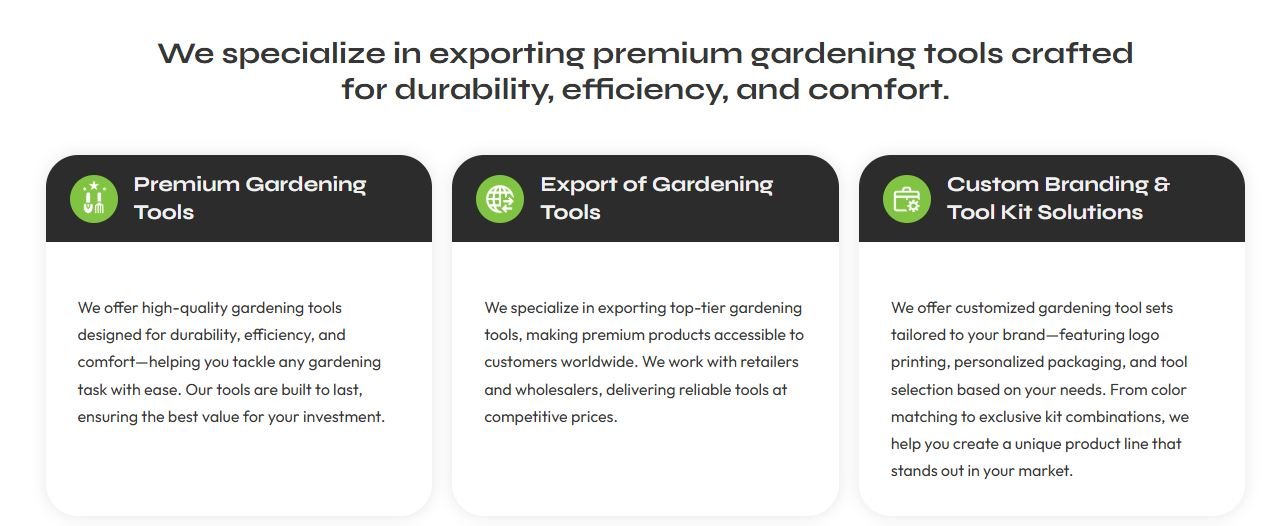
Bell Tower Co. has operated from Zhejiang since 2014 as a factory-direct partner for wholesale garden tool buyers, primarily across Europe and the Balkans. Our OEM and private label program includes custom box artwork, branding and logo placement, low MOQs designed for small and mid-size distributors, and CE, ISO, and SGS documentation on request. Standard terms are $5,000 minimum order and 30/70 T/T. English-speaking account management runs from first inquiry through shipping, so nothing gets lost between the buyer, the QC bench, and the freight forwarder.
Questions You Might Have
What is the difference between OEM and private label garden tools?
Private label means an existing product sold under your brand with custom packaging and minor spec choices. OEM means the factory builds to your engineering spec, including custom moulds or handle geometry. Private label is faster and cheaper. OEM gives you a fully proprietary product.
What is a realistic MOQ for private label garden tools from China?
MOQs vary sharply by supplier. Large factories often require several thousand units per SKU. Bell Tower is set up for smaller buyers, with a $5,000 minimum total order and low per-SKU MOQs. Custom packaging carries its own separate MOQ because printed boxes are produced in a distinct run.
How long does a private label launch take?
Plan on 60 to 90 days from signed branding brief to goods in your warehouse for a first order. Reorders move faster because artwork, samples, and QC checkpoints are already approved.
Do I need to register a trademark before launching?
Yes, register in your target markets before goods arrive. Trademark disputes are far more expensive to resolve once goods are in warehouses.
Ready to Launch Your Own Brand?
If you are planning a private label line and want MOQs, sample lead times, and packaging options for your target SKUs, contact Bell Tower for a sourcing quote. Our team will come back with the specifics you need to price the launch.